Lot's of different pics of this sign.

Lot's of different pics of this sign.
"I don't make hell for nobody. I'm only the instrument of a laughing providence. Sometimes I don't like it myself, but I couldn't help it if I was born smart."

1st Sgt. Milton Anthony Warden.
"From here to Eternity"

Paul Valery

"You are in love with intelligence, until it frightens you. For your ideas are terrifying and your hearts are faint. Your acts of pity and cruelty are absurd, committed with no calm, as if they were irresistible. Finally, you fear blood more and more. Blood and time."

The Wisdom of the Ages

"When a young man, I read somewhere the following: God the Almighty said, 'All that is too complex is unnecessary, and it is simple that is needed',"

Mikhail Kalashnikov
"Here lies the bravest soldier I've seen since my mirror got grease on it."

Zapp Brannigan

Sunday, August 27, 2006

Chain Saws

The Hicks knife project continues apace. I forged the blade a few days ago and will give a progress report in a few days.
In the meantime, in the driveway, I've got four cords of Doug fir and Ponderosa pine lily pads (log offcuts for those who don't live in timber country). That's what is, at present, taking up all my time, energy and piece of mind. The good news is that the little woman authorized the purchase of a new saw. I would have cheaped out and done that which I always do: buy an antique and fight with it, but she insisted we spend the long dollar.
Thus I have the first new saw of my life, a Husqvarna 455 Rancher. Woo-hoo. I'll not post any glam shots of it as I'm sure the Huskie marketing department has me beat on that account. I did however find myself waxing nostalgic over past back-breakers. My first was a "Holiday". Great name for a saw or what. It was a Canadian version of a Pioneer that dated from the Kennedy administration. Not a lot of power but plenty heavy. Next was a 1970's Stihl which was a nice rugged saw that I bought used and worked the hell out of for ten years. I also buried, in the past year, a Porter-Cable electric chain saw from around 1960 that my dad bought at a garage sale for $10. I put a $15 sprocket on it and ran it for almost thirty years until it came apart into two pieces (literally) about six months ago.
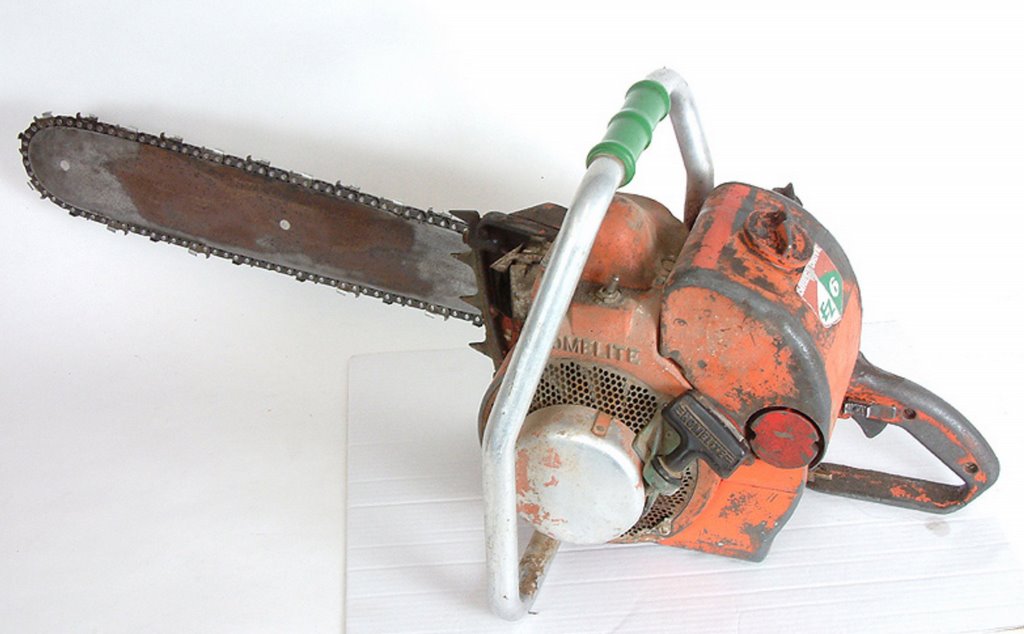
Anyway, in the spirit of the overweight, under-powered power saw, as the loggers say, here are some pictures gleaned from the web. At the top is a saw made by The Power Machine Manufacturing Co of Vancouver, BC. I'm sure I don't miss never having used this one.
Next is a saw called a "David Bradley". I have no idea who he was but one of the pictures showed the name Fairbanks-Morse on the bar. Also original paint, except maybe the orange. Very cool.
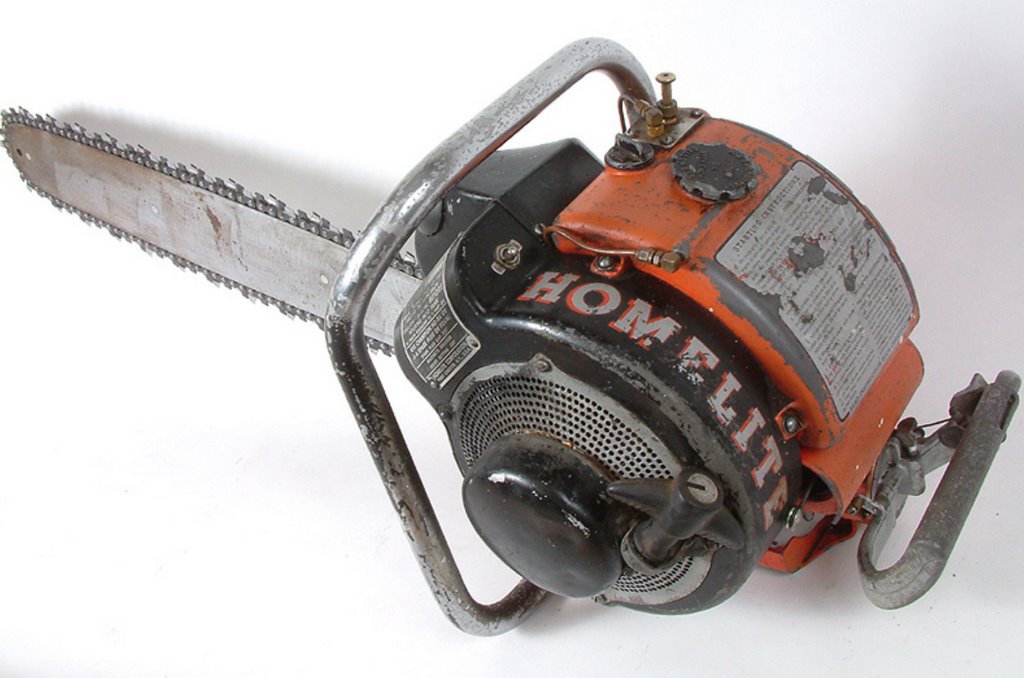
The father of one of my buddies in grade school owned one of Missoula's saw shops and the next picture is a matchbook from same, circa 1965; followed by a photo of a Homelite that looks to be the one pictured. And lastly another Homelite, this one of a vintage before all-position carburetors where the carb could be rotated ninety degrees for felling. I was truly a simpler time.

Thursday, August 17, 2006

Back To A. G. Hicks...

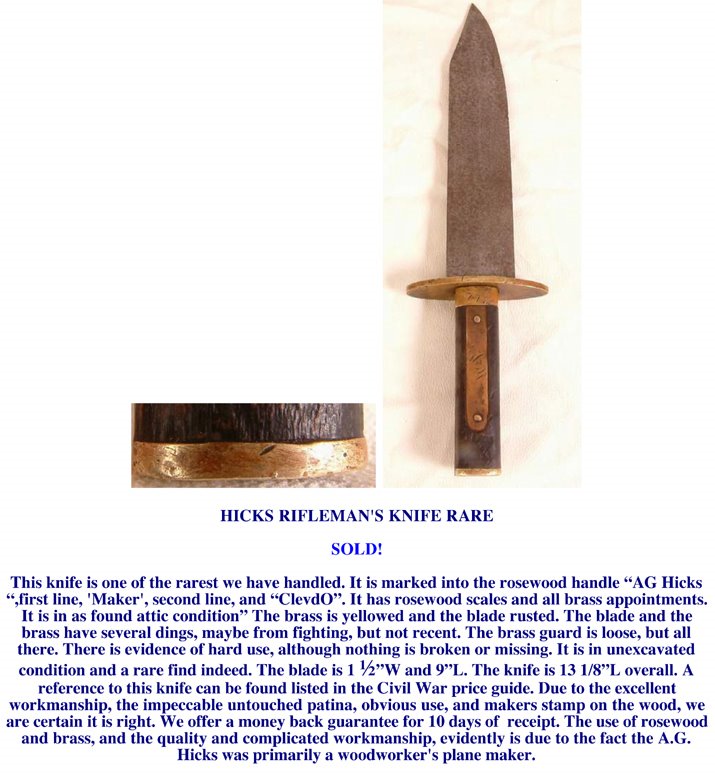
I've been chewing on the Hick's knife idea for some time now - to the extent that I wandered all over town looking for 1/16" X 5/8" brass, flat stock. I'm ready to bite the bullet but one question remains unanswered: A. G's ethnicity. It's either unimportant or I'll find out later. In any case his knives are interesting.
This example,at the top (from Wes Cowan's excellent website. I find lots of cool knives there) exploded my original thinking, based on the only other picture I'd seen thus far, I'd seen of his blades, that the guard/ferrule combination had been cast as a single piece. Reading the copy attached to the above photo, we have confirmed that he was a planemaker, and that goes some distance toward the why of the unusual construction he uses. Anyway, the brass fittings appear to be built-up from flat stock, which only makes sense, now that I think about it. A maker of handplanes would have little need to cast metals. Brass used there is mostly in the form of wear-strips.
For a little context, here's a jack plane from about the same period (1840"s). I bought this thing solely because it had a Butcher iron. I hoped to be able to build another plane around it. As you can see, the iron has been used to the point that a few more sharpenings are going to have eaten as far as the cap-iron, mounting slot. Ah well...
However, what I do find interesting is this: The plane is American. At the front it is stamped "(beat into illegibility by LOTS of hammer marks) Tool Co. New York". But the iron is English. Not too surprising for the period around 1830's-40's. The U.S. was producing steel at that time but not in the quantity or to the standards, of the products of Sheffield. There's a closeup of the iron trademark in the upper-left. "W. B. Butcher, Warranted Cast Steel, Sheffield, England". The question is this: If a period planemaker in New York state was using imported irons; would a colleague, in the wilds of Ohio, use anything but Sheffield blades for his Bowie knives? Not a big issue. I just like to be able to impart the appropriate level of crudity in construction.
As soon as I can get caught-up, I'd like to bang out a Hick's and see how it does on the website.

Saturday, August 05, 2006

More Weird Revolvers


Dropping the ball... I checked the blog out yesterday and saw that my last post was Thurs. which caused me to think "It wasn't that recently." Over a week! Shamefull! Sorry for the exclamation points. That's shamefull as well.
Now to the business at hand: Since my initial foray into bizarre and oddball handguns, more have come under my gaze, and so, we shall begin:
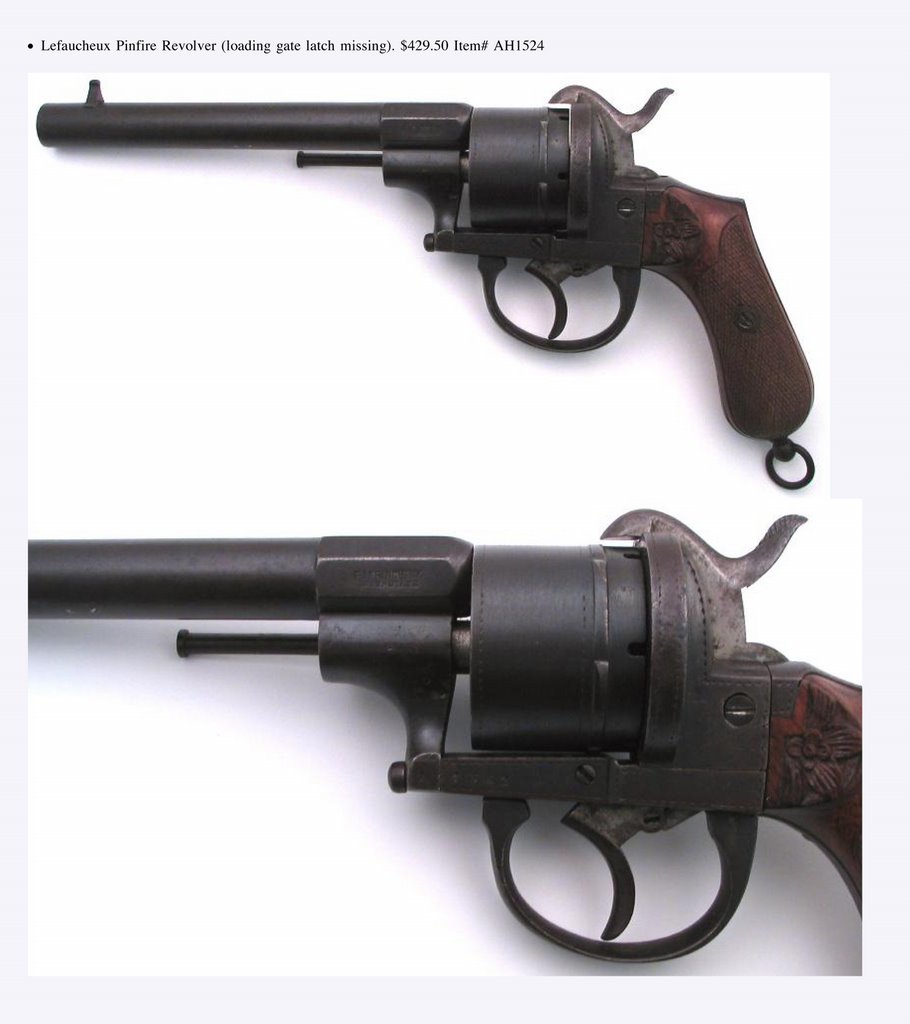
First business first. Back in the day I showed the two strange-looking French handguns and betrayed my ignorance with the "...starts with an 'L'" copout. To the left, another one which was purchased by the U. S. Government during the War of Northern Aggression. The name is, as you can see, Lefaucheux.
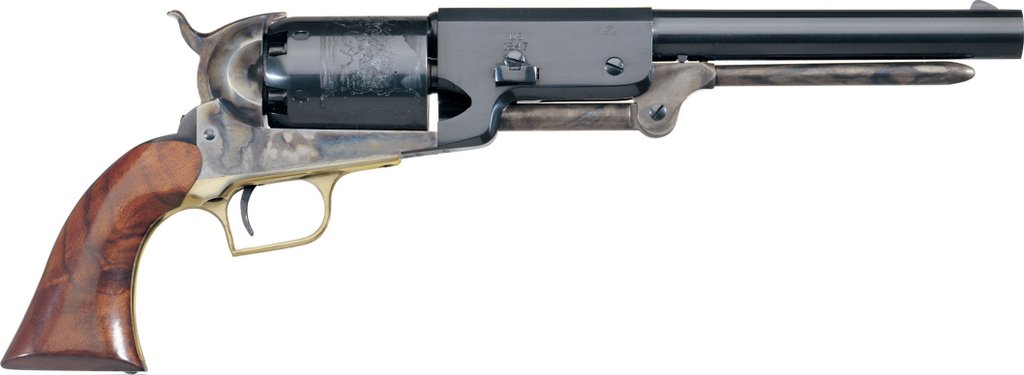
Next, just to give a frame of reference, is a modern copy (Uberti) of the largest handgun ever made. At 4 1/2# loaded and fifteen inches long, the 1847 Walker Colt was a monster. While the 1873 Army Springfield Trapdoor rifle loaded a 45/70 round - 45 caliber shoved along by 70 grains of black powder - the Walker effectively shot a 44/60. It had muzzle energy to rival that of a 357 magnum and, up till the time that caliber was developed in the thirties, the Walker was the most powerful handgun in existence. One point I'll get to later: Notice the loading lever - the lever under the barrel that pushes the ball, powder and wad into the chambers.
That being said, the next offering is an Allen and Wheellock pocket pistol.
Apparently this gun's claim to fame was a simplified cylinder release. Simplified from a production standpoint, not a tactical one. Consequently it was mostly produced in these small civilian versions. However, what strikes me as a nice piece of engineering is that the loading lever does double-duty as the trigger guard.
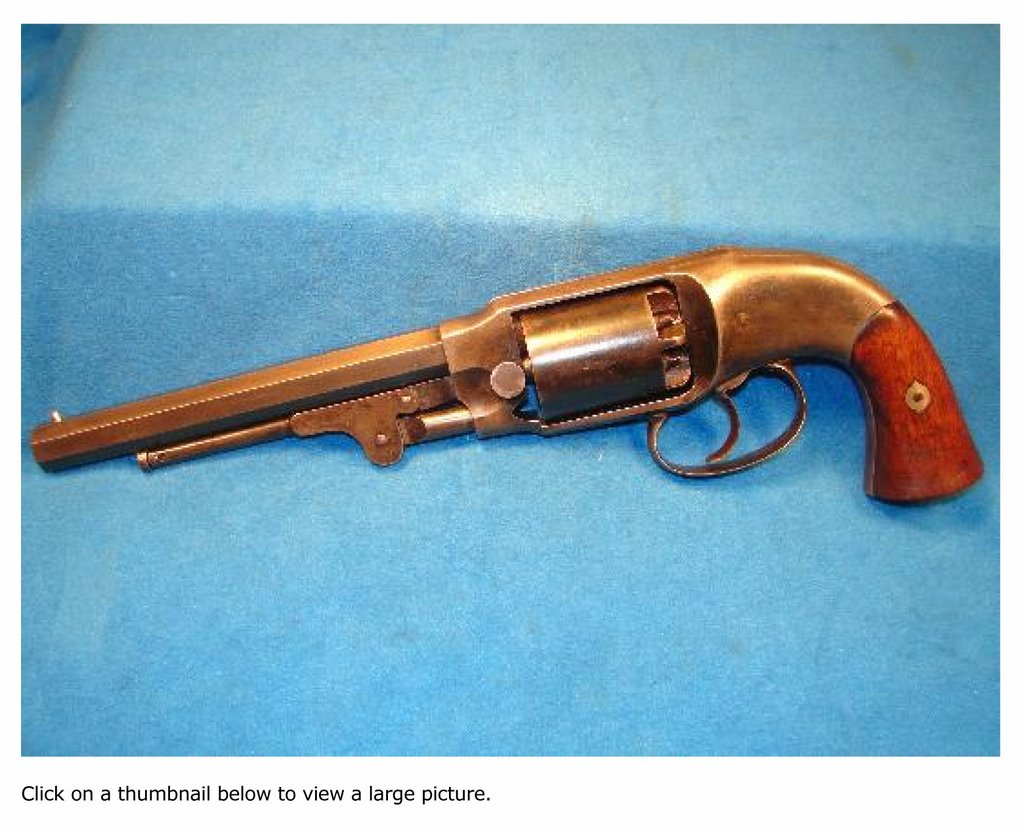
Now one with a normal loading lever setup but outlandish looks otherwise. I really don't know much about this one. It does seem to point to a gradual feeling the way, among designers, regarding what a pistol should look like. The Pettingil Army.


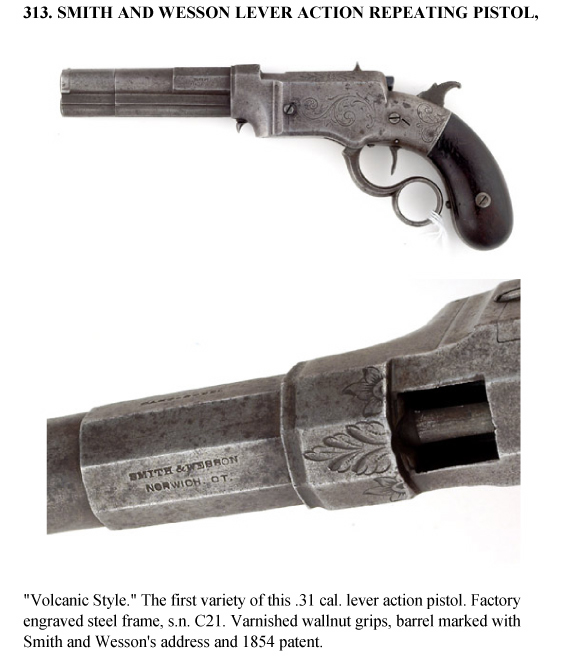
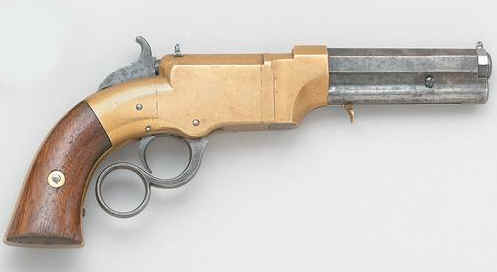
In conclusion, a teaser for next time, and I have no idea why the text is underlined. It's no secret that the metalic cartridge was invented by Smith and Wesson. This is the pistol that was intended to shoot it. Pay attention to the cocking lever, just forward of the trigger, and the tubular magazine under the barrel. Where have you seen that before? The final image, a Volcanic Pocket pistol, may give a hint as to what it finally developed into.
Locations of visitors to this page