Lot's of different pics of this sign.

Lot's of different pics of this sign.
"I don't make hell for nobody. I'm only the instrument of a laughing providence. Sometimes I don't like it myself, but I couldn't help it if I was born smart."

1st Sgt. Milton Anthony Warden.
"From here to Eternity"

Paul Valery

"You are in love with intelligence, until it frightens you. For your ideas are terrifying and your hearts are faint. Your acts of pity and cruelty are absurd, committed with no calm, as if they were irresistible. Finally, you fear blood more and more. Blood and time."

The Wisdom of the Ages

"When a young man, I read somewhere the following: God the Almighty said, 'All that is too complex is unnecessary, and it is simple that is needed',"

Mikhail Kalashnikov
"Here lies the bravest soldier I've seen since my mirror got grease on it."

Zapp Brannigan

Thursday, June 29, 2006

Patternmaking


This may be the last post for a week or so. Another evil empire, Qwest, has determined that even though the phone bill is now paid - a month late, my fault - they're still going to shut off the internet and it can't be turned back on until next Wednesday. Good job, phone company! As soon as pracical, I'll be looking for service elsewhere.
Enough whining about my fiscal irresponsibility. I wrote earlier regarding making the casting patterns for the Confederate Sniper's Knife without going into any detail. Essentially I turned them out of wood as if they were vessels of some sort. The pommel like a small cup and the guard like a plate. Judicious cutting away later gave me nice symetrical wood patterns to work with.
Well, in more detail, here's the how of my latest casting pattern:
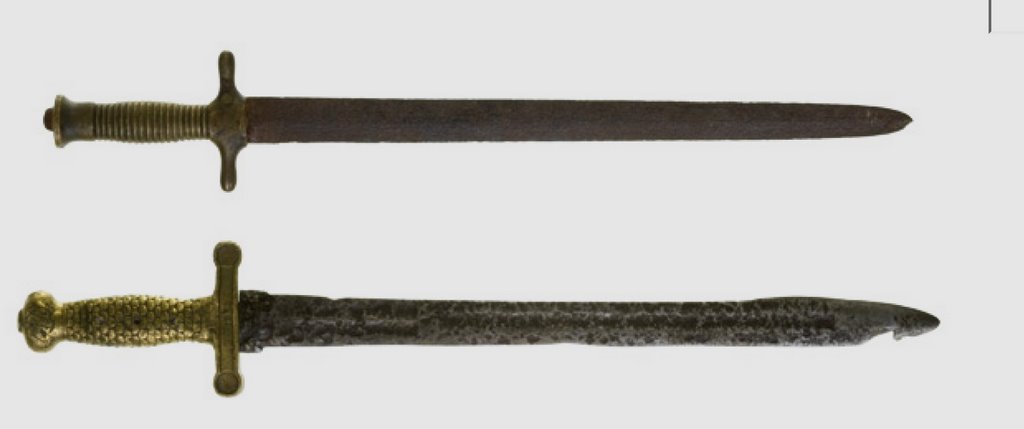
First of all, at the top of the page is a picture of two artillery short swords. The lower one is the Ames model, used by the US Army in the Mexican War as well as the Civil War and copied by the Confederates. Myself, I've always thought it looked like something Charleton heston would have carried in "Spartacus". The upper one, a European example from the same period (1830's), is tasteful and understated - and easy to turn with no silly eagle pommels or fish scales to carve.


First pic. A disc of bulletwood glued onto a 3/4" stub turned onto the end of a chunk of walnut, as it sits on the lathe.
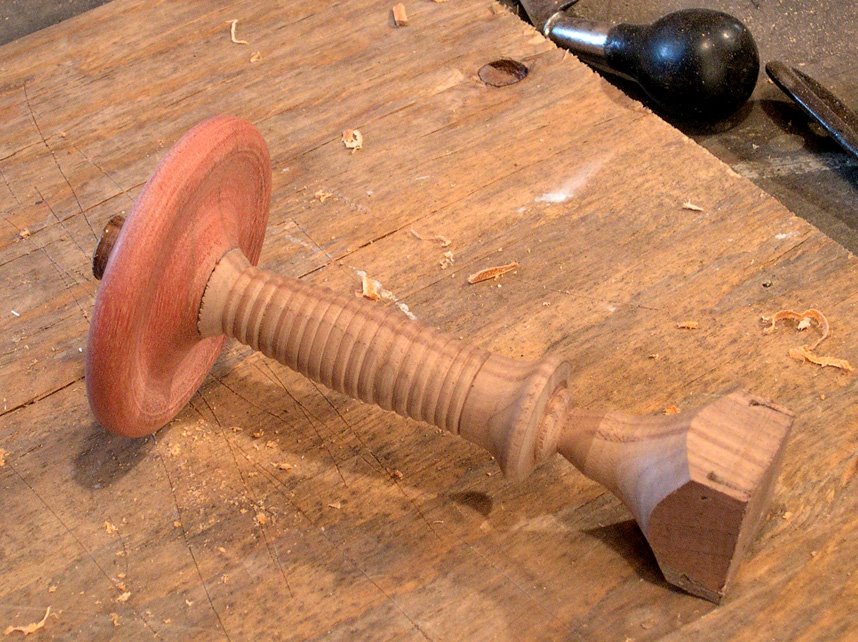


Next, the finished turning. The square block at the pommel end facilitated gripping the piece in the lather chuck.
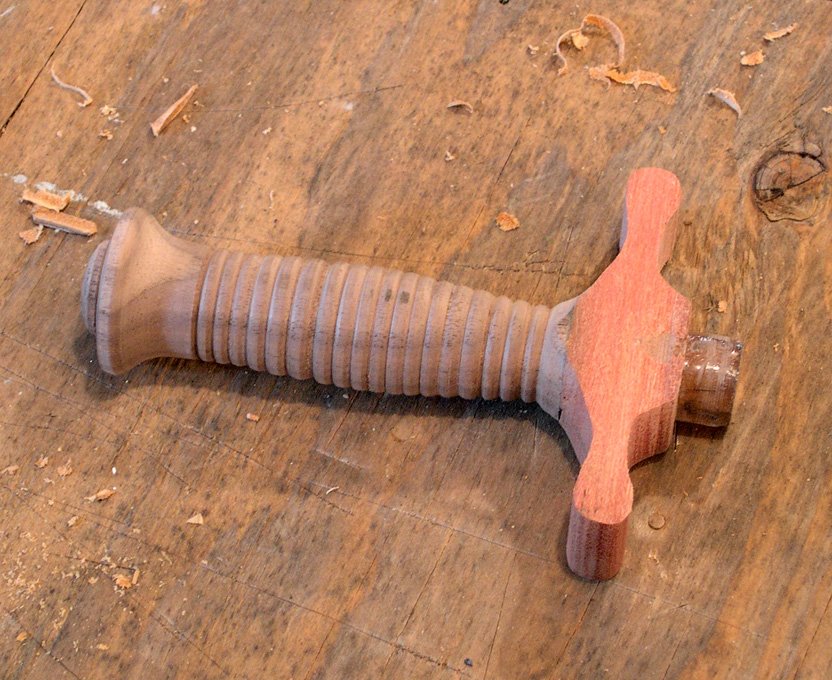

Lastly, some careful cutting away of all the parts of the disc that didn't look like a guard left me with a workable wooden pattern in an hour or so. The next step is to cast it in aluminum and fine-tune it for my final, working pattern.

Saturday, June 24, 2006

What's with the tutu?

Oh man. The Madogre made a crack about my "skirt". It's a tutu, George.
Maybe an explanation is in order lest someone think I have ballet skills and wants me to audition for the lead in "Giselle" or something. The whole thing could get quite embarassing.
Long, long ago, when I first started making knives and selling them on E(vil empire)-Bay and dreaming of the day when I could have my own website, I started shopping around other knife sites to see how they were put together. In short, I suffered some feelings of insecurity in the face of all the very polished "photos of the artist" pictures I ran across. With no real purpose to it other than a symbolic "me too", I came up with the tutu photo. I like it. It was even taken on a film camera, my old Canon FTbrick (for sale by the way) and colorized to look old-timey. And, I think you should all be pleased that I wasn't wearing tights, that my lunacy had some limits.

Thursday, June 22, 2006

Stainless steel and A. G. Hicks

I'm realizing that I may be leaving some loose ends to tie up, specifically in my flagrant dissing of the high-chromium steels that the commercial knife manufacturers (and their marketing departments) have foisted upon the American public with their claims to their being "stainless". First of all, lets hear from woodworking plane-iron maker, Ron Hock. He says it far better than anyone, especially me, ever could. He also helps illustrate my point that: No tool actually intended to CUT some intractable material (like curly cherry - for example) is ever made from anything but plain old high-carbon. Hock himself makes his irons from 1095. He played around with A2 for a while and a couple of my planes have Hock A2 irons in them and they're great. Sharpen easily, stay sharp a long time and that's really what it boils down to (that to which it boils down - I'm a drop out from Journalism School - I can't help myself).
Many members of knife-breaking clubs other than ABSCOW (gotta change that acronym) are fond of a tool steel designated D2. It's got a fair chunk of chromium in it, about 1.5% which is generally more than a high-carbon steel has of carbon but it's not enough for it to be called "stainless". The chromium helps a lot in its intended use however. It deepens the effect of the quench, adds abrasion resistance and some other goodies that escape my mind at the time. One of its claims to fame is that a piece of D2 with a thick cross-section will heat-treat with a minimum of distortion. Not an attribute knives require in general - but one that is very handy in a material intended for situations where thick pieces of steel, shaped into complex shapes, have to withstand intense heat and pressure repeatedly - like forging dies or injection-molding dies (that's what the "D" stands for). Is it a bad steel for knives? No, of course not. It's possibly harder to sharpen than a "real" blade steel like 1095 but it works. Only because - and here's where it gets heretical, folks - a piece of steel, as a knife blade, doesn't have to work very hard. A simple woodworking cabinet scraper, which has a nearly microscopic edge - it's just a burr or "wire-edge - will keep that tiny sliver of metal sharp while you bear down on it to take out the humps in whatever wood we're talking about. It will get so hot it's hard to hold on to but still cuts. That workout would have to equal - dressing out, I don't know how many, elk - to put a knife edge through a similar beating.
In closing, I recall an online ad from the Union Cutlery Co. AKA Kabar regarding their new and improved D2 version of the venerable M2 fighting/utility knife - forever hereafter known as a "Kabar" even though a half dozen firms other than them manufactured them. The copy read: "The military may have been happy with their blades of 1095, hardened to Rc 5? but the modern knife enthusiast demands better." What? All those jarheads down in the hell of the South Pacific didn't place demands on their blades to equal those of a "modern" user. I don't even want to talk about what's obscene about that statement.
Steel rusting is God's way of telling us to take care of our tools.
In closing, the title mentions A. G. Hicks who I know was a maker of woodworking planes in Cleveland in the 1840's, and who made the occasionsal Bowie knife. What I've heard, but can't remember where, is that he was a free black. (Sorry, PC police, for me to say "African American" I'd have to demand you all call me a "Scottish American"). I just can't confirm it and I like to factual in my little blurbs - and I want to make at least one Hicks knife. Anyway, to close up shop for the day, here's a pic of some of A. G. Hick's shivs.

Tuesday, June 20, 2006

Wheelguns


My new baby to the left. A Beretta Stampede 357 with a 4 3/4" (gunfighter length barrel. I've always felt that I never had enough money to be a proper gun nut - and a succession of ex-wives thought that that was a retrograde step, evolutionwise and let me know repeatedly. I've since altered my thinking somewhat as well as the wife situation - number four is sane, relatively. Anyway, my reasoning is as follows: If I've purposed in my heart to be a gun nut, then I must make enough money to finance it. I'll have no choice. Sound thinking I believe.
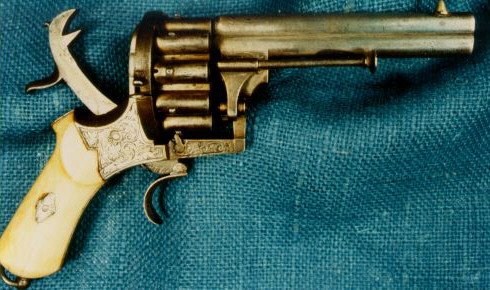
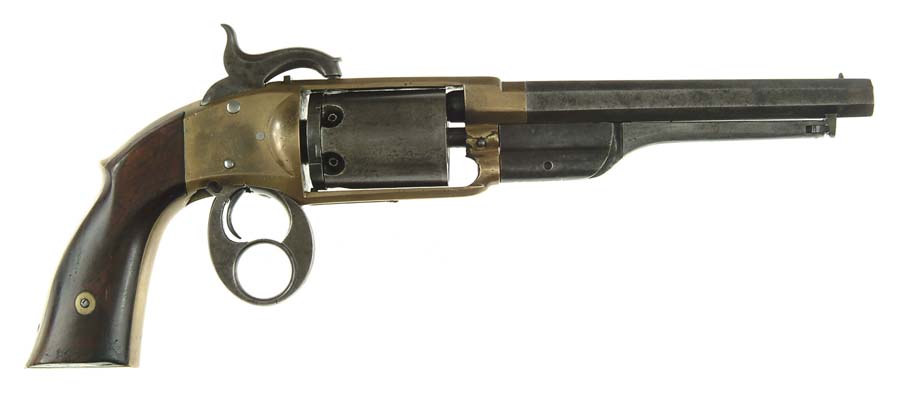
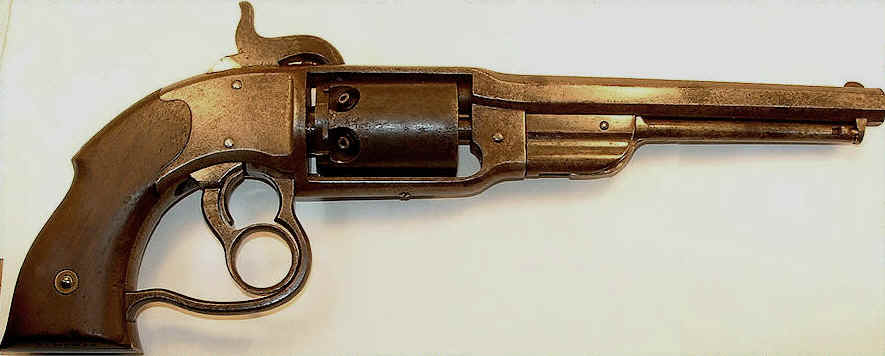
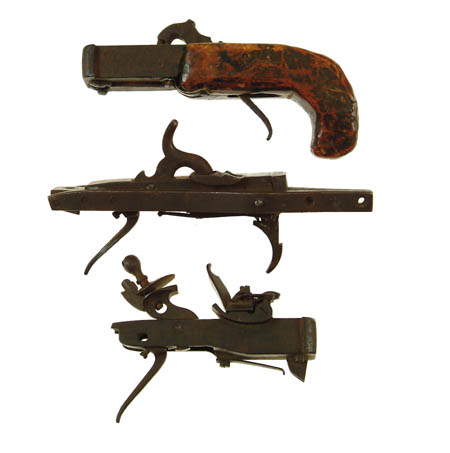
In the process I've expanded my porno viewing to include looking at pictures of guns and to that end, I'm going to present some interesting ones that, I feel, lead to the conclusion that the Colt, 1873 Single Action Army, the gun my darling was patterned after, is the most elegant revolver ever made.


This is a 22 shot Belgian revolver, made in 1836. Not a 22 caliber - a twenty two shot pistol. The chambers are in two concentric circles and the two spurs on the hammer fire one circle, then the other.


Next are two examples of Savage "figure-eight revolvers" so called because of the thus-shaped trigger guard. This actually isn't a dumb idea. You cock it by pulling back on the lower loop, then firing with your index finger. Apparently this is a different Savage altogether than the more recent (post 1890's) one but I got that info from Wikkipedia so it's somewhat suspect.


Now, the ultimate prizewinners for weird-looking handguns, two French ones. I'm sure everyone who's into this knows the name of them. It starts with an "L". I just didn't bother to retain it. I'm no French basher such as is common these days but I have to say that these look to be some of the clumsiest things ever produced by the hand of man. But they are pretty in a Western/Science Fiction sort of way.


Last ones isn't a revolver but it's precious anyway. It's a pistol cobbled together from the breech block of a Hall rifle. The Hall was an early breech-loader. Rotating the trigger guard caused the breech to raise so that powder and ball could be loaded withought having to do the entire process from the muzzle. I just love this thing. It seems to be a good idea and probably worked fine. It's just so ugly. Maybe that's what makes it loveable, I don't know.

More to follow. In the meantime, visit my website. Buy a knife or twelve. These guns aren't going to buy themselves

Thursday, June 15, 2006

Survival Knives


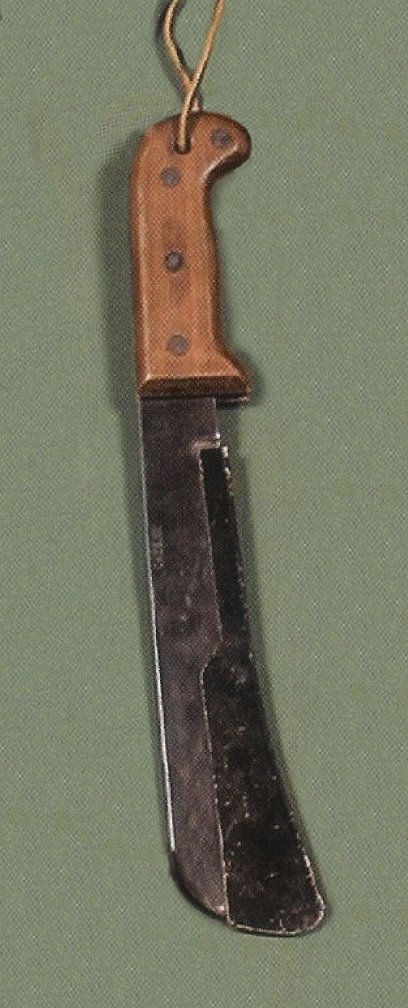
First things first. To the left, a better photo of the Case V-44 that I stumbled across.

My lad bought a survival knife yesterday which is why I'm going to expound on a blade-related subject I've been chewing on for some time.

The knife he bought, $10 at Big 5, was a good deal by any standard. It's pretty typical of the type though and there are many things about them that I find silly.
First of all, they invariably have a hollow handle of aluminum containing matches, fishing line and hooks and the like. Having those things in the same package as the knife is a good idea but I think a more solid handle would be preferrable. I don't know where I'd put the stuff. I just think that solution sucks. And why matches? They absorb moisture and the handle can only hold 10 or so. Why not a Bic lighter, especially in view of how the quality control in the kitchen match industry has gone to hell.

Now, the compass. These are of a level of sophistication equal to the ones you played with as a kid - even on the high end examples. A compass is so fickle due to odd hunks of iron that may be about and even ore-bearing rock, that if you're going to have one it ought to be a good one. You can get a good lensatic compass, adjustable for declination, for twenty bucks and they don't weigh anything. Not only that, you can find true north by either the stars at night or by the path of the sun during the day far more reliably than the dime-store compass on the knife. If you can't you've got no business being out in the woods.

I remember the old Rambo style knives with those goofy spikes on the guard that you were supposed to configure into some sort of half-assed grapple. Okay...

These blades are also invariably made from the shittiest steel available. Always stainless which is bad enough, but often 440C which isn't even a good stainless unless you're making flatware. The reasoning is that the blade will stay shiny so you can use it for a signal mirror. Not a bad idea if you didn't have to completely sacrifice blade quality to have something to signal with. People have signaled aircraft with sunglass lenses. It's not rocket science. Throw a CD in your backpack. It's even got an aiming hole in it.
Lastly, and this is somewhat off the topic, I read an article a while back where the author, a hobby pilot, wanted to design a "survival knife". A major part of his criteria was that it be light weight. On the face of it, not patently stupid but considering the fact that he'll throw a thermos of coffee or an extra sweater and a book to read when he reaches his destination into his plane with out a second's thought, saving a few ounces on this piece of "life or death" equipment seems ridiculous. I think in the worst-case scenario where he sticks his plane in the ground, he'd be far happier crouching in his little shelter in the deep dark woods with a Big Fucking Knife rather than a thin, stylish little folder.
Anyway, the lad bought a survival knife and like I said: You can't go wrong for ten bucks. Good job Big 5 and all you Chinese minions.

Thursday, June 08, 2006

The great "Bowie" knife controversy

A potential customer wrote a few days ago wanting me to duplicate the Bowie knife from the movie "The Alamo". I hadn't seen the flick and hadn't wanted to since the old one with John Wayne had been my all time favorite movie for about a year when I was six. Anyway, I saw it.
As I was cruising around on the web seeing if any manufacturer was making movie knives since Jason Patric spends the only time the knife is onscreen flipping it around like a Ninja, I kept running into "The Case Alamo Bowie". Now Case is an old respected producer of cutlery but their standards, at least regarding nomenclature, are clearly slipping. The above mentioned knife is nothing more than Case's - still being manufactured - V-44 with a cocobolo handle.
The V-44 is the term (incorrect, but I'll get to that later) given to any number of homemade and production, Bowie bladed knives intended to be included as machetes in aircraft survival kits.
During the second war, virtually every country on the allied side made some variation, Australia, India and China. I make a reproduction of New Zealand's contribution that I call "The Son of Gung Ho Knife".


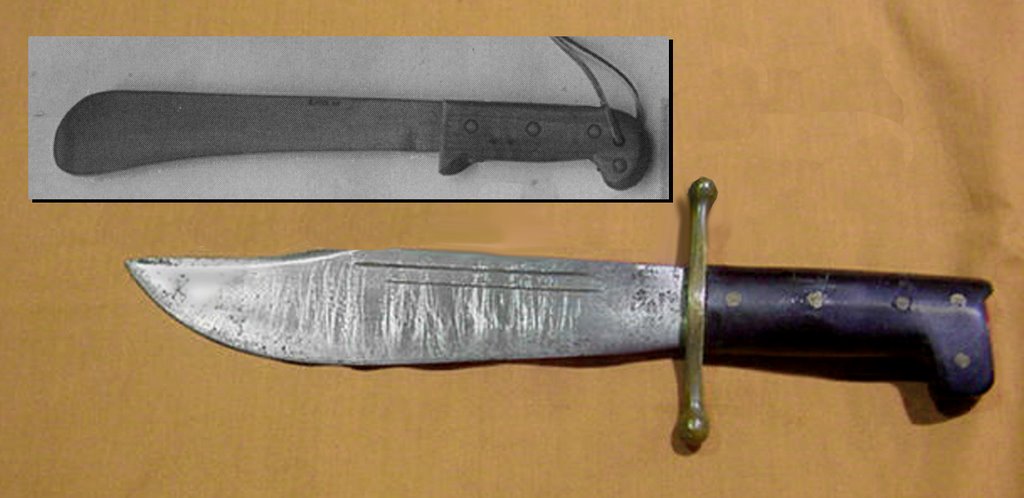
The photo above shows the "original" V-44. The colored picture is of a Collins #18 machete. Made by the Collins axe company, it was adopted by the Army Air Corps as a bailout knife in 1935. The Marines famously used them on Guadalcanal and they turned out to be just so sexy that everyone had to have one. Collins made them, Western made them...and Case made them. And everybody, and his dog, in the third world made them. They are Bowies. They've got the appropriate blade shape and the size. They just don't come close to being the knives used during the period one normally thinks of when one hears the words "Bowie knife" and they most certainly weren't at the Alamo in this form.
To close on a note of even greater confusion: The knife in the BW inset photo is the real V-44. Produced in 1944 (hence the number designation) for the Navy as a - you guessed it - survival kit machete. And the maker of this rather prosiac tool? Case Cutlery.

Sunday, June 04, 2006

Sunday Morning

The rifleman's knife is done. It's on the site here and I think it turned out rather nice. The brass casting went well also but the extra 400 degrees or so difference from melting aluminum made my gas forge work harder than it ought to. I'm in the process of building a dedicated, melting furnace but I tried to cheap out and not buy/make "real" refractory. I don't think it's going to work and I'll have to bite the bullet and either buy refractory or find a source for bentonite and make some. Something I should have done from the beginning but for the perils of having an anxiety disorder.
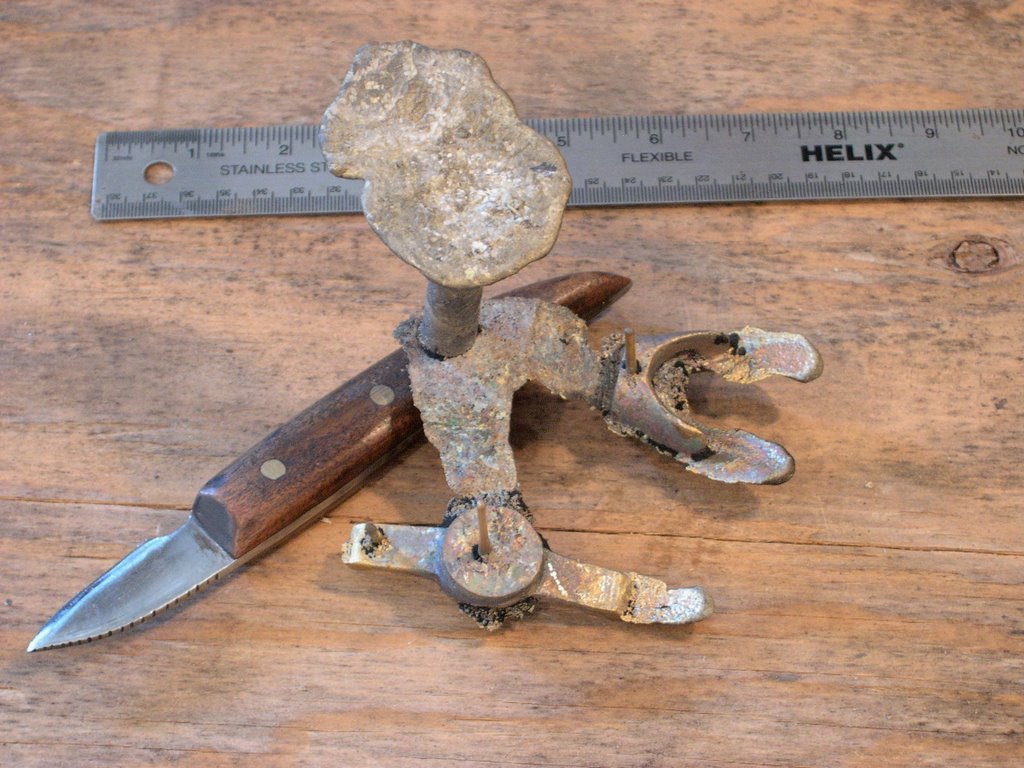
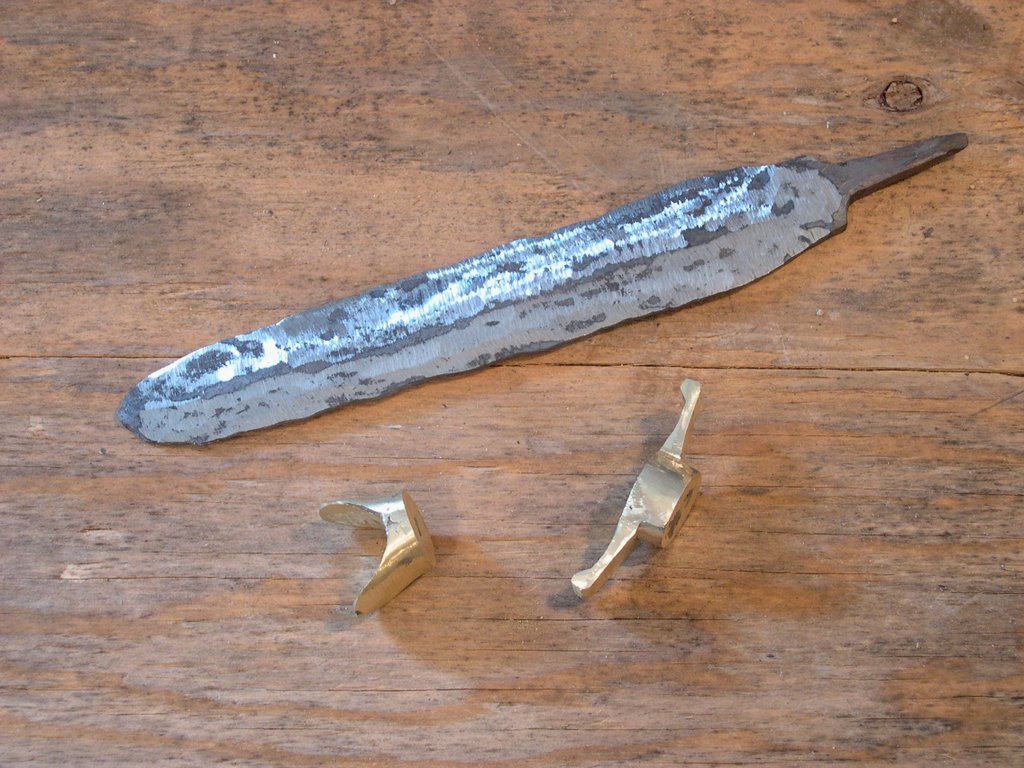
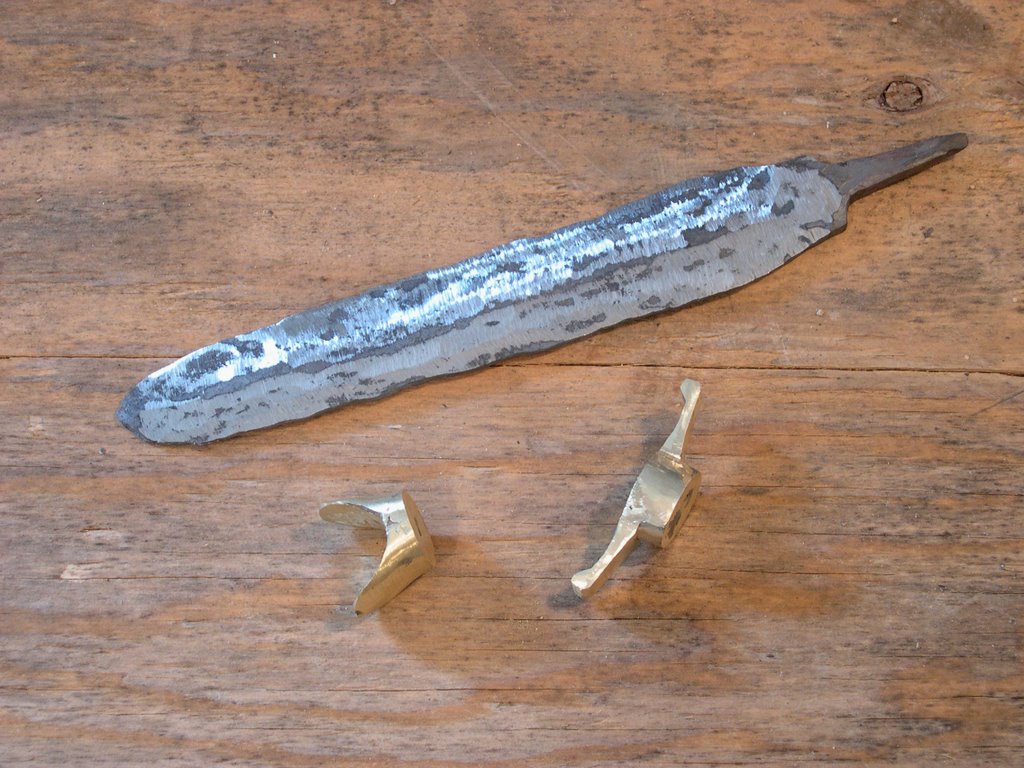
Below is a pic of the rough casting and below, one of them finished with the blade.


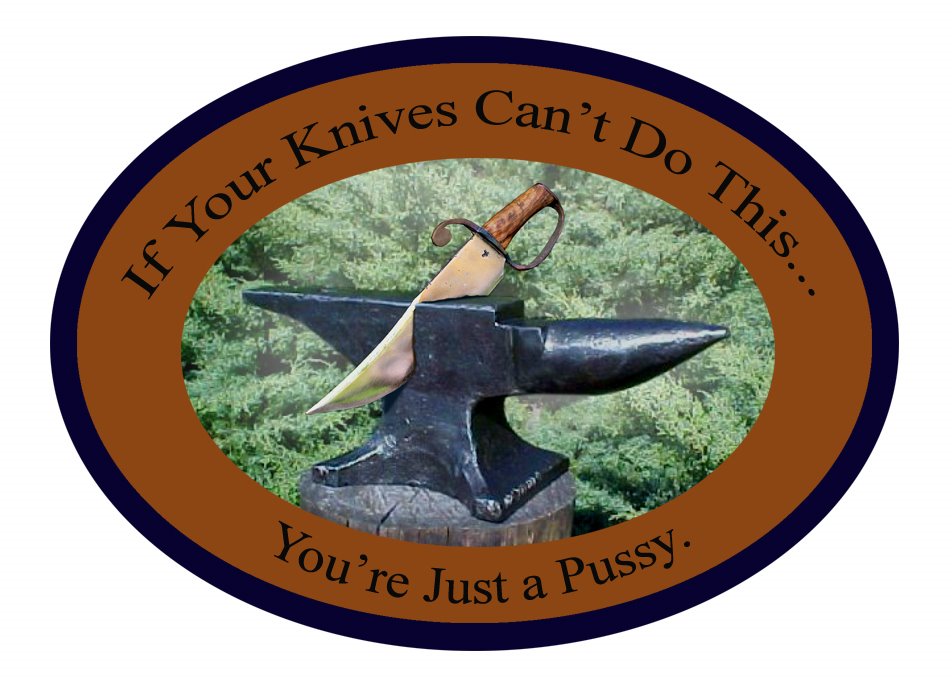
In addition, I've been refining my bad attitude regarding the elitist knifemaking clubs and have come up with my own logo for ABSCOW (I'm probblay going to change that acronym but it'll do for now). You'll find it below. Feel free to rip it off and make it your own. The knife is one of mine and the anvil pic came from E-(vil empire)Bay. It's a 137# Trenton.
Some people shouldn't be allowed to use Photoshop.


Locations of visitors to this page